
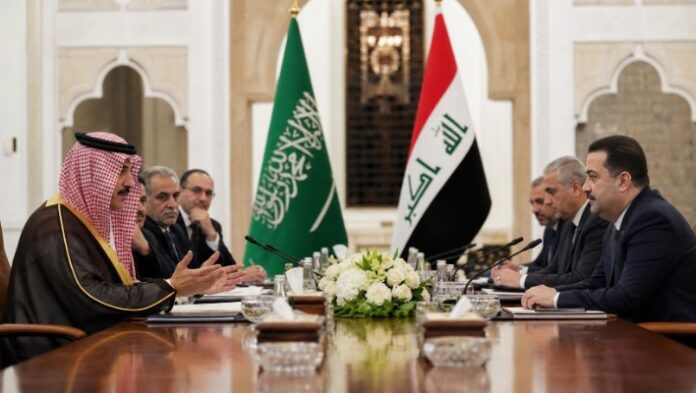
Saudi intelligence chief Khalid Al-Humaidan met Iraqi Prime Minister Ali al-Zaidi in Baghdad and renewed an invitation to visit Riyadh following tensions caused by recent US-Saudi strikes in Iraq.
Saudi Arabia’s intelligence chief, Khalid Al-Humaidan, has met Iraqi Prime Minister Ali al-Zaidi in Baghdad as the two countries seek to repair relations strained by recent military action in Iraq.
During the meeting, Al-Humaidan renewed an invitation for the Iraqi prime minister to visit Riyadh, according to reports. Al-Zaidi had postponed a planned trip to Saudi Arabia following joint US-Saudi air strikes against Iran-aligned armed groups in Iraq on 29 July.
The visit indicates that both governments are attempting to preserve diplomatic engagement despite disagreements over security, sovereignty and the activities of armed groups operating in Iraq.
Riyadh renews invitation to Iraqi prime minister
Al-Humaidan reportedly delivered the renewed invitation during talks with Al-Zaidi in the Iraqi capital. The date of a possible visit to Riyadh has not yet been announced.
The Iraqi leader’s earlier trip was postponed after the strikes prompted condemnation from Baghdad. Iraq described the military action as a violation of its sovereignty and convened an emergency meeting of its National Security Council.
The strikes targeted sites associated with Iran-aligned groups. US and Saudi officials said the operation was directed against groups accused of attacking American forces and Saudi energy infrastructure.
At least 20 fighters and six Iranian advisers were killed, according to an Associated Press report. Iraqi officials also reported civilian casualties, although accounts of the overall toll differed.
Security cooperation remains central
Security cooperation was reportedly a central part of Al-Humaidan’s discussions in Baghdad. Both countries face concerns about armed groups, cross-border attacks and the possibility that Iraq could become a battleground for wider regional rivalries.
Saudi Arabia has repeatedly called on Baghdad to prevent Iraqi territory from being used to launch attacks against neighbouring countries. Iraq, meanwhile, has said it will not allow its territory to be used as a base for attacks but has also objected to foreign military operations conducted without its approval.
Al-Zaidi had ordered an investigation into allegations that drones targeting Saudi facilities were launched from Iraqi territory.
The latest talks suggest that Riyadh and Baghdad are seeking direct communication to prevent security disputes from causing a prolonged diplomatic rupture.
Economic relations also at stake
The relationship extends beyond security. Saudi Arabia and Iraq have sought to expand cooperation in trade, energy, infrastructure and agriculture in recent years.
Iraq needs foreign investment to rebuild infrastructure and diversify its economy, while Saudi Arabia views stronger economic links with Baghdad as part of its wider regional strategy.
A deterioration in relations could delay planned investments and bilateral agreements. The renewed invitation therefore appears intended to restore political dialogue and keep economic cooperation on track.
Readers can follow related Middle East developments on Hams Live News.
Regional tensions complicate rapprochement
Closer Saudi-Iraqi relations face significant obstacles. Iraq maintains close political and economic relations with Iran, while several Iran-aligned armed factions operate within the country.
Some of these groups are incorporated into Iraq’s state security structure through the Popular Mobilisation Forces, complicating Baghdad’s efforts to control their activities without provoking domestic instability.
Saudi Arabia sees a stable Iraq as important for regional security and as a potential economic partner. Baghdad, however, must balance its relationships with Saudi Arabia, Iran and the United States while defending its sovereignty.
The US military presence in Iraq and escalating confrontation with Iran add further uncertainty to this diplomatic effort.
What happens next
Al-Humaidan’s visit represents an attempt to reopen high-level communication following the postponement of Al-Zaidi’s trip.
The next indication of progress will be whether Baghdad and Riyadh agree on a new date for the Iraqi prime minister’s visit. Any future talks are expected to address security coordination, regional de-escalation and economic cooperation.
For now, the renewed invitation signals that Saudi Arabia and Iraq remain interested in preventing the recent military confrontation from causing lasting damage to bilateral relations.

