
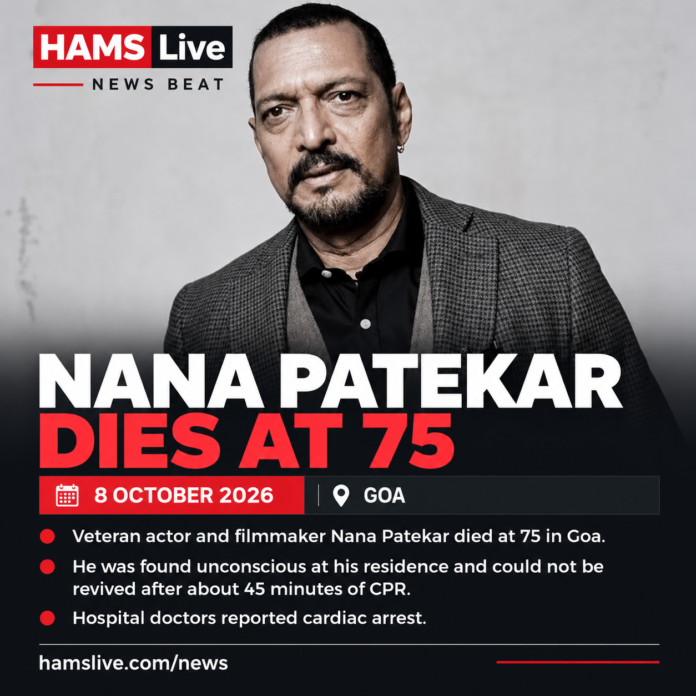
Veteran actor Nana Patekar, known for his intense performances, distinctive voice and remarkable range, dies at 75 after cardiac arrest
Veteran Indian actor Nana Patekar, one of the most distinctive performers in Hindi and Marathi cinema, died in Goa on Thursday, October 8, 2026, at the age of 75.
Patekar was found unconscious at his residence in Dona Paula, Goa, in the early hours of Thursday and was taken to Manipal Hospital. Doctors attempted to revive him for around 45 minutes, but he could not be saved. He was declared dead at approximately 5:20 am. Hospital sources said he had suffered a cardiac arrest, while a medico-legal case was registered and his body was sent for post-mortem examination. Details of his final hours in Goa were reported following his death.
His son, Malhar Patekar, confirmed his death. The actor’s passing prompted tributes from across Indian cinema and public life. Prime Minister Narendra Modi, President Droupadi Murmu and Vice President C. P. Radhakrishnan were among those who expressed grief over the loss. Tributes from the President, Vice President and Prime Minister highlighted Patekar’s contribution to Indian cinema and his wider public life.
Patekar’s death brings to an end a career spanning nearly five decades across Marathi theatre, Hindi and Marathi cinema, direction and social work. He was an actor whose screen presence could be intimidating, vulnerable, comic or deeply restrained, often within very different kinds of roles.
Nana Patekar’s Career: From Marathi Theatre to Hindi Cinema
Born Vishwanath Patekar in Maharashtra on January 1, 1951, Nana Patekar began his artistic journey in Marathi theatre before establishing himself in films. He made his screen debut with Gaman in 1978 and gradually built a reputation through a succession of supporting and character roles.
His breakthrough came with Vidhu Vinod Chopra’s Parinda in 1989, in which he played the gangster Anna. The performance brought him the National Film Award for Best Supporting Actor and established him as one of the most formidable character actors in Hindi cinema. His major performances and awards across the decades reflected a career that repeatedly moved beyond conventional character-actor roles.
What distinguished Patekar was not merely the intensity of his acting, but his ability to move between dramatically different characters without becoming trapped by a single screen persona. He could play a gangster, policeman, soldier, politician, troubled civilian or comic character while making each role feel distinct.
His work in Prahaar: The Final Attack, which he also directed, demonstrated his interest in both performance and filmmaking. He subsequently earned acclaim for films including Tirangaa and Krantiveer, with the latter earning him the National Film Award for Best Actor.
In Khamoshi: The Musical, Patekar revealed another side of his acting. As Joseph, a deaf father, he relied heavily on expression, gesture and physical presence rather than the forceful dialogue delivery for which audiences had come to know him. The performance showed that the actor associated with explosive intensity could also communicate profoundly through restraint.
His range extended into mainstream comedy. In Welcome, he played the gangster Uday Shetty, turning the seriousness and authority that had defined many of his dramatic roles into a major source of comedy. The performance introduced his work to another generation of mainstream audiences.
He later appeared in films including Prakash Jha’s Raajneeti, in which he played the politically astute Brij Gopal, and Natsamrat, which brought his theatrical roots into sharp focus.
Three National Film Awards
Patekar’s career was recognised with three National Film Awards, underlining the breadth of his work rather than a single defining screen image.
He won the National Film Award for Best Supporting Actor for Parinda in 1990, the National Film Award for Best Actor for Krantiveer in 1995, and another Best Supporting Actor award for Agni Sakshi in 1997.
The three honours reflected different facets of his acting. Parinda established his ability to portray menace, Krantiveer demonstrated his command of a central and emotionally charged role, while Agni Sakshi added another psychologically complex character to his filmography.
Patekar was also awarded the Padma Shri in 2013 for his contribution to the arts. The official 2013 Padma Awards notification lists Nana Patekar among the awardees in the field of Art.
Theatre Remained Central to Nana Patekar’s Identity
Long before his success in Hindi cinema, Patekar developed his craft on the Marathi stage. Theatre helped shape the dialogue delivery, physicality and emotional intensity that subsequently became hallmarks of his screen performances.
Unlike actors who gradually abandoned theatre after achieving success in films, Patekar continued to regard the stage as an important part of his artistic identity. His theatrical background remained visible in the way he used his voice, body and pauses to build a character.
That connection became particularly evident in Natsamrat, in which he played an ageing theatre actor confronting the loss of his professional identity and changing family relationships. The role brought together two important strands of his career: Marathi theatre and his ability to inhabit emotionally demanding characters.
Nana Patekar’s Social Work and NAAM Foundation
Patekar was also known for his involvement in social causes, particularly the problems faced by farmers and rural communities in Maharashtra.
His activism eventually took organisational form. In September 2015, Patekar and fellow actor Makarand Anaspure spearheaded the NAAM Foundation, responding to drought, water shortages and the distress of farmers in Maharashtra.
The foundation’s work includes farmer welfare, water conservation, restoration of water resources and development of disadvantaged villages. Its official trustees information records Patekar’s association with the organisation.
The foundation became one of the most prominent expressions of Patekar’s public life beyond cinema. His concern for farmers became part of his broader public identity, and he frequently spoke about rural distress and the need to address the circumstances contributing to farmer suicides and water scarcity.
An Actor Whose Public Life Was Not Without Controversy
Patekar’s career was not without controversy. In 2018, actor Tanushree Dutta accused him of sexual harassment over an alleged incident on the set of Horn ‘OK’ Pleassss in 2008. Patekar denied the allegations.
The controversy became part of India’s wider #MeToo discussion, which brought renewed public attention to allegations of sexual harassment and workplace misconduct in the entertainment industry.
In 2019, Mumbai Police filed a B-summary closure report, saying there was insufficient evidence to proceed with the allegations. At the time, the report still required consideration by the magistrate, so it would be inaccurate to describe the development simply as a judicial acquittal.
Dutta subsequently challenged the police findings and continued to dispute the conclusions of the investigation, including in her response to the police’s findings. Her response to the closure report became another part of the public record surrounding the controversy. The allegations, the police investigation and the subsequent legal process should therefore be described separately rather than conflated.
A Distinctive Presence in Indian Cinema
Nana Patekar’s career ultimately resisted easy categorisation. He could be menacing and vulnerable, outspoken and restrained, dramatic and comic. From Parinda and Prahaar to Krantiveer, Khamoshi, Raajneeti, Welcome and Natsamrat, he repeatedly demonstrated that intensity did not have to mean repetition.
His roots in Marathi theatre remained visible even after he became a major Hindi film actor. At the same time, his willingness to move between serious drama and mainstream entertainment prevented him from being confined to the conventional category of a character actor.
His performance style was particularly recognisable. The voice, pauses, physical stillness and sudden bursts of emotion could make even a short scene memorable. Yet beneath the forcefulness was an ability to communicate vulnerability and uncertainty, which helped prevent many of his characters from becoming one-dimensional.
His final years also reflected a life increasingly divided between cinema, rural interests and social work. Reports following his death highlighted his connection with farming and his preference for a relatively simple life away from the glamour traditionally associated with Bollywood. His relationship with rural life and farming remained an important part of his later public image.
Nana Patekar’s Legacy
Patekar’s contribution to Indian cinema was not defined by conventional stardom. It was defined by presence.
He brought an unmistakable voice, physical intensity and theatrical discipline to roles that could otherwise have become familiar stereotypes. He could dominate a scene with a monologue, create tension through silence, or turn the seriousness of a gangster into comedy.
That range helped make him one of the most recognisable actors of his generation.
His death at 75 marks the passing of a distinctive acting personality whose career crossed linguistic and cultural boundaries. For audiences who encountered him through Parinda, Krantiveer, Khamoshi, Raajneeti, Welcome and Natsamrat, he leaves behind a collection of performances that remain difficult to imitate.
For the theatre community, he represented the enduring influence of the stage on Indian screen acting. For those associated with his social work, particularly the work of NAAM Foundation, his legacy extends beyond cinema.
Nana Patekar did not build his reputation by playing the same character repeatedly. He built it by making audiences believe that the person on screen had a life, history and emotional world beyond the frame.
That is perhaps the quality that made his performances memorable—and the reason his absence will be felt across Indian cinema.

