
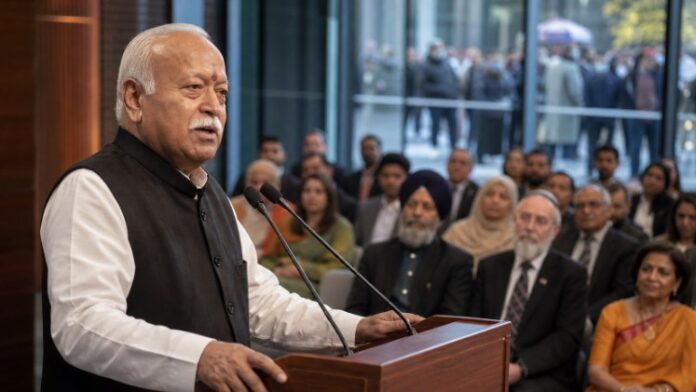
Mohan Bhagwat rejected calls for a Muslim-free India in New York, as Indian and international reports framed his visit differently.
Rashtriya Swayamsevak Sangh chief Mohan Bhagwat rejected the exclusion of Muslims from India during an address in New York on Saturday, 29 August 2026. Indian reports published after the speech highlighted his declaration as a message of religious inclusion, while prominent international coverage published before the event concentrated on protests, religious-freedom allegations and disagreements over the RSS within the Indian diaspora.
Addressing a faith-leaders’ session connected with the Universal Oneness Celebration at the Infosys Theater in Madison Square Garden, Bhagwat recalled being asked whether the RSS concept of a Hindu Rashtra meant that Muslims would be driven out of India.
“If any Hindu thinks that there should be no Muslim in Bharat, he will not remain Hindu,” Bhagwat said, according to video excerpts and reports by the Indian Express and other Indian news organisations.
The remark formed part of a broader address about human dignity, religious diversity and what Bhagwat described as the underlying unity of humanity.
RSS chief Mohan Bhagwat said excluding Muslims from India was incompatible with Hinduism. His message of unity came amid protests and competing narratives about the RSS in the United States.
What Bhagwat said about Muslims and Hindu Rashtra
Bhagwat recalled questions put to him by members of the Muslim community during an RSS lecture series in Delhi in 2018. He said Muslims had asked how they would fit within the RSS vision of a Hindu Rashtra and whether that idea implied their expulsion from India.
In response, Bhagwat argued that Hindu thought recognises multiple paths to the same ultimate truth and does not require the disappearance of other religious communities.
He said diversity should be preserved and described it as an expression of an underlying human unity. In his formulation, Hindu identity is not based on removing Muslims, Christians or followers of other faiths from India.
Bhagwat also discussed dialogue between religious communities, saying that social change could not be achieved through politics alone. According to the Indian Express, he argued that religious and social organisations might seek to influence public policy, but their work had to begin within society.
The statement about Muslims was therefore not an isolated comment. It was part of his explanation of how the RSS understands Hindu identity, social engagement and coexistence among different communities.
Indian reports focused on the inclusion message
Indian coverage published after the address largely led with Bhagwat’s declaration that a person seeking a Muslim-free India would not remain true to Hindu principles.
The Times of India, Indian Express, India Today and Hindustan Times all used the statement as the central element of their reports.
Several Indian outlets described the address as a message of unity in diversity. Some also connected the remarks with Bhagwat’s outreach to Muslim and Christian representatives following the RSS lecture series in 2018.
This framing centred on what Bhagwat said during the New York programme: Muslims could not be excluded from India under his understanding of Hinduism and Hindu Rashtra.
Some Indian reports published before the programme had covered the controversy surrounding the visit, including criticism from New York Mayor Zohran Mamdani and demonstrations planned by civil-rights groups. Once the speech was delivered, however, Bhagwat’s statement about Muslims became the dominant headline.
International reports emphasised protests and the RSS record
Prominent international reports available before the address adopted a markedly different starting point. The Associated Press focused on protests against Bhagwat’s visit, criticism from Mamdani and calls by the US Commission on International Religious Freedom for action against individuals associated with the RSS.
AP described the RSS as a Hindu nationalist organisation widely considered the ideological parent of Prime Minister Narendra Modi’s Bharatiya Janata Party. It also cited critics who accused the broader Hindutva movement of contributing to hostility and discrimination against religious minorities.
The report nevertheless included the organisers’ and RSS’s position. RSS spokesperson Sunil Ambekar said the programme reflected an Indian tradition that was inclusive and welcoming and that Bhagwat would address a multicultural and multifaith audience.
Al Jazeera’s reporting similarly concentrated on demonstrations and allegations that the visit was intended to improve the international image of the RSS. It quoted activists who questioned whether the event’s message of unity was consistent with the experiences of Muslims, Christians and other minorities in India.
The international stories examined were therefore built primarily around who Bhagwat represents, why his visit was contested and how Hindu nationalism has divided sections of the Indian-American community.
Why the difference in coverage matters
The contrast between the headlines is clear, but timing explains a significant part of it. The major AP and Al Jazeera reports cited here were published before Bhagwat delivered his speech. They were previews of a politically contentious event, not post-speech assessments of his statement about Muslims.
Indian articles carrying the inclusive declaration appeared after the address and had access to remarks unavailable when the international previews were prepared.
It would consequently be inaccurate to claim that international outlets deliberately ignored Bhagwat’s statement. A more precise conclusion is that the Indian post-event reports and international pre-event reports covered different stages and dimensions of the same visit.
The Indian reports examined focused principally on what Bhagwat said. The international reports examined focused on the controversy surrounding his appearance and the competing views of the RSS. Neither perspective alone provides the complete picture.
Organisers presented the gathering as an interfaith event
The programme was organised by the American Hindus for Engagement and Dialogue Forum, commonly known as AHEAD Forum. According to the official event statement, more than 250 Hindu-American organisations participated in the Universal Oneness Celebration.
The programme was organised around Vasudhaiva Kutumbakam, the Sanskrit concept meaning “the world is one family”. Organisers said it was intended to encourage unity, civic responsibility, interfaith understanding and service.
The programme coincided with Raksha Bandhan and expanded the festival’s theme of mutual responsibility beyond families to communities, nations, humanity and nature.
Participants included religious representatives, educators, businesspeople, medical professionals, artists, community organisations and youth leaders. The gathering was expected to attract approximately 5,000 people.
The organisers describe the RSS as a volunteer-based social and cultural organisation involved in community service, education, disaster relief and social harmony.
Protests exposed divisions within the diaspora
A coalition of interfaith and civil-rights organisations opposed Bhagwat’s appearance and called on Madison Square Garden to cancel the programme. The participating groups reportedly included Hindus for Human Rights, the Indian American Muslim Council, the Interfaith Center of New York and organisations representing Sikh, Christian and Dalit interests.
The critics argued that the RSS’s influence in India was inconsistent with the event’s language of universal inclusion. RSS supporters rejected that portrayal, accusing opponents of misrepresenting the organisation and disregarding its social-service work and right to peaceful assembly.
Mamdani said he did not support the event and described the RSS vision as exclusionary. However, he also acknowledged that New York City might not have the authority to cancel a lawful private gathering.
The controversy illustrated divisions within the Indian diaspora over Hindu nationalism, minority rights and the extent to which political debates from India should shape community relations in the United States.
Religious-freedom commission’s role requires context
The US Commission on International Religious Freedom recommended targeted measures against people and entities it linked to serious religious-freedom violations, including the RSS.
USCIRF is an independent, bipartisan federal advisory commission. It makes recommendations to the US president, State Department and Congress, but its findings do not automatically become US government policy.
India’s Ministry of External Affairs rejected the commission’s assessment, describing USCIRF as biased and lacking credibility. That response is important because allegations made by the commission remain contested by the Indian government.
Reports should therefore distinguish among USCIRF recommendations, formal US government policy and claims made by advocacy organisations. They are not interchangeable.
Does the statement settle the Hindutva debate?
Bhagwat’s New York statement was clear: seeking the expulsion or disappearance of Muslims from India is incompatible with his conception of Hinduism. Supporters of the RSS are likely to view the address as evidence that Hindu Rashtra, as understood by the organisation, represents a cultural and civilisational identity rather than a state that excludes non-Hindus.
Critics are likely to argue that the meaning of the declaration must be assessed against political rhetoric, public policy and the experiences of minority communities inside India.
One speech cannot settle every dispute concerning the RSS or Hindutva. It would be equally unreasonable, however, to dismiss the statement without acknowledging its explicit rejection of religious exclusion.
Two narratives surrounding the RSS
The New York programme brought two competing accounts of the RSS into direct contact. The first presents it as a social and cultural organisation promoting service, national unity and a broad civilisational understanding of Hindu identity. Bhagwat’s rejection of Muslim exclusion supports that account.
The second portrays it as the central ideological force behind a majoritarian political movement whose growth has coincided with increased concern about the treatment of minorities. The demonstrations and international criticism reflected this interpretation.
Bhagwat made an explicit statement against excluding Muslims. The programme was promoted as multicultural and interfaith. It also attracted organised protests from groups that dispute the RSS’s presentation of itself, while India rejected the criticism issued by the US religious-freedom commission.
The difference between Indian and international coverage is therefore not simply a matter of one side being favourable and the other hostile. It reflects different editorial priorities, publication times and intended audiences.
Indian post-speech coverage highlighted Bhagwat’s words. International pre-event reporting explained why his appearance had become controversial. Reading both provides a fuller account than relying on either frame alone.
For further background on debates involving the RSS and public institutions, read Hams Live News’s report on Raj Thackeray’s demand concerning an IPS officer’s alleged RSS-BJP sympathies.
This analysis is based on video excerpts and Indian post-event reports, international reporting published around the visit, the organisers’ official material and India’s publicly reported response to USCIRF.

