
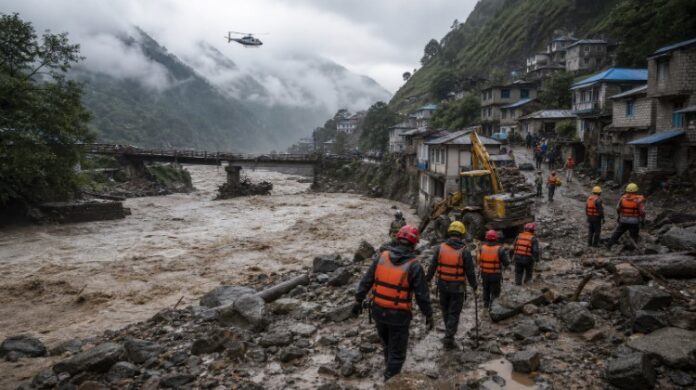
Nepal–Tibet flash floods have killed 392 people, while nearly 290 Indians remain out of contact and two unstable lakes pose fresh flood risks.
Catastrophic flash floods along the Nepal–Tibet border have killed at least 392 people and left more than 1,400 unaccounted for, as of Friday morning, 28 August 2026. Nearly 290 Indian nationals remain out of contact, while Nepal and China have warned that two newly formed barrier lakes could release further destructive surges.
The confirmed total includes 389 deaths in Nepal and three in the Tibet Autonomous Region of China. Nepalese and Chinese authorities have reported a combined 1,468 people missing, although the figures remain provisional and may change as communication is restored and duplicate entries are removed.
India’s Ministry of External Affairs initially said it had been unable to contact 288 Indian nationals. Subsequent reports rounded the figure to about 290. “Uncontactable” does not necessarily mean confirmed missing or dead: some people may be stranded in areas where telephone and internet services have collapsed.
What caused the disaster
The floods began Wednesday, 26 August, when an enormous mass of rock and ice collapsed near the Nepal–Tibet border. Scientists believe the avalanche temporarily blocked a river before the accumulated water and debris broke through, sending a powerful torrent into the Bhote Koshi river system.
The United States Geological Survey initially registered the event as an earthquake but later reclassified it as a glacial collapse and debris flow.
Preliminary analysis by the Kathmandu-based International Centre for Integrated Mountain Development indicated that an ice-rock avalanche was the probable trigger. Researchers are examining whether a temporary natural dam intensified the flood before suddenly failing.
Water levels at one monitoring point on the Trishuli River reportedly rose by as much as nine metres within approximately 30 minutes, illustrating how little time downstream communities had to escape.
Death toll reaches 392
Nepal Police reported that 389 bodies had been recovered across several districts by Thursday night. Three additional deaths were reported on the Tibetan side, taking the combined confirmed toll to 392.
The figures increased rapidly as bodies were recovered farther downstream. Nepal Police reported recoveries from Rasuwa, Nuwakot, Dhading, Chitwan, Gorkha, Tanahun and the eastern and western parts of Nawalparasi.
Nepal’s Ministry of Foreign Affairs had confirmed 359 recovered bodies in an update issued at 8 pm Nepal time Thursday. It cautioned that casualty and missing-person figures remained subject to verification.
Authorities subsequently reported a higher toll as recovery operations continued. Differences between official updates reflect the rapidly evolving situation and the time required to consolidate information from multiple districts.
Nearly 290 Indians remain uncontactable
India’s Ministry of External Affairs said Thursday that contact could not be established with 288 Indian nationals believed to have been in the affected region. Later reports placed the number at approximately 290.
Those out of contact include Kailash Mansarovar pilgrims, tourists and employees working at hydropower projects. Destroyed telecommunications infrastructure and the isolation of several settlements have made it difficult to determine their whereabouts.
At least 84 Indian nationals had reportedly been rescued by Friday morning. They included 63 workers from the Trishuli-I hydropower project and 21 travellers from Tamil Nadu.
About 200 other Indians on the Chinese side had requested help. Some were reported to be safe but stranded in locations including Darchen, Jilong, Zutulphuk and Saga while awaiting evacuation or assistance with onward travel.
External Affairs Minister S Jaishankar said Indian authorities were coordinating with the governments of Nepal and China, Indian state administrations, tour operators and diplomatic missions to locate affected nationals.
The official number may continue to fluctuate as rescue teams establish contact with stranded groups. Family members should therefore rely on government or embassy updates rather than unverified social-media lists.
Two barrier lakes pose a fresh threat
The danger has not passed. Nepal and China are monitoring two lakes that formed after debris blocked rivers on their respective sides of the border.
Nepal’s disaster authority warned that water was accumulating behind debris near the original flood site. If this natural barrier fails suddenly, another surge could travel through already devastated downstream settlements.
Chinese authorities issued a separate warning concerning an overflowing lake near the confluence of the Tsogyal and Purupqiangzangbu rivers. Approximately three million cubic metres of additional water could reportedly enter the lake over several days, increasing the possibility of a breach.
Authorities have advised residents, relief workers and rescue teams to remain away from vulnerable riverbanks. People in downstream communities have also been urged to follow evacuation instructions without delay.
The precise timing and scale of any breach cannot be predicted with certainty. Continuous hydrological monitoring is therefore crucial.
Rescue operations face major obstacles
More than 30,000 Nepalese security and emergency personnel have reportedly been mobilised. Helicopters, drones, boats, earthmoving machinery and ground teams are being used to find survivors and reach isolated communities.
Operations have been slowed by extensive infrastructure damage. More than 35 bridges and approximately 40 kilometres of roads have reportedly been destroyed or damaged, cutting off settlements and restricting the movement of heavy rescue equipment.
Mud, boulders and wreckage have covered residential areas and sections of road. Floodwaters also damaged hydropower facilities, government buildings, markets, farms and the infrastructure surrounding the Nepal–China crossing.
Nepal Police reported rescuing hundreds of people by air and evacuating hundreds more by land. Rescue totals are being revised as information arrives from different agencies.
India, China, the United States, the United Nations and other international partners have offered or begun providing assistance. Prime Minister Narendra Modi spoke with Nepalese Prime Minister Balendra Shah and offered India’s support for the emergency response.
Foreign tourists among those missing
Nepal’s Foreign Ministry said people from more than 30 countries were among those reported missing. Many foreign nationals were visiting the region for trekking, organised tours or the Kailash Mansarovar pilgrimage.
Nepal reported hundreds of missing foreign tourists, while Chinese officials said foreign nationals were also among those unaccounted for in Tibet.
The number of missing people should be treated cautiously. Registers maintained by immigration offices, tour operators, hotels, pilgrimage organisers and local authorities may overlap. Some travellers may also have moved to safer areas without being able to contact relatives or officials.
Rescuers are searching for more than 1,400 missing people after catastrophic floods struck the Nepal–Tibet border. Nearly 290 Indian nationals remain uncontactable, while authorities are monitoring two unstable barrier lakes.
Growing Himalayan glacier risks
The disaster has renewed concern about the effects of rising temperatures on Himalayan glaciers and high-altitude lakes.
Glacier retreat can create or enlarge lakes held back by unstable ice, moraine or debris. An avalanche, landslide, intense rainfall or structural failure can release the impounded water with little warning, producing a glacial lake outburst flood.
A similar flood struck the same border region in July 2025, killing people and destroying the Friendship Bridge connecting Nepal and China.
Scientists have not completed their investigation into the August 2026 disaster. It would therefore be premature to attribute the event to a single cause. The initial evidence points to a rock-and-ice collapse followed by temporary river blockage and a sudden release of water and debris.
Readers can follow continuing regional coverage through Hams Live’s Nepal news archive.
Emergency contacts for Indian nationals
The Embassy of India in Kathmandu has published the following emergency telephone and WhatsApp numbers:
- +977 985 131 6807
- +977 970 910 7500
- +977 981 032 6117
Nepal’s Ministry of Foreign Affairs Emergency Control Room can be reached between 7 am and 10 pm at:
- +977 974 444 1227
- +977 974 444 1228
- Email: [email protected]
Relatives seeking information should provide the person’s complete name, passport details, telephone number, travel operator, itinerary and last known location. Sensitive identification documents should not be posted publicly on social media.
What happens next
The casualty toll is likely to change as rescuers reach inaccessible areas and officials reconcile lists of missing residents, workers, tourists and pilgrims.
The most immediate concerns are locating survivors, identifying recovered bodies, evacuating threatened communities and monitoring the two barrier lakes. Restoring roads, bridges, electricity and communication networks will be essential for both rescue work and longer-term relief.
This report reflects information available on the morning of 28 August 2026 and should be updated when Nepalese, Chinese or Indian authorities publish revised figures.

