
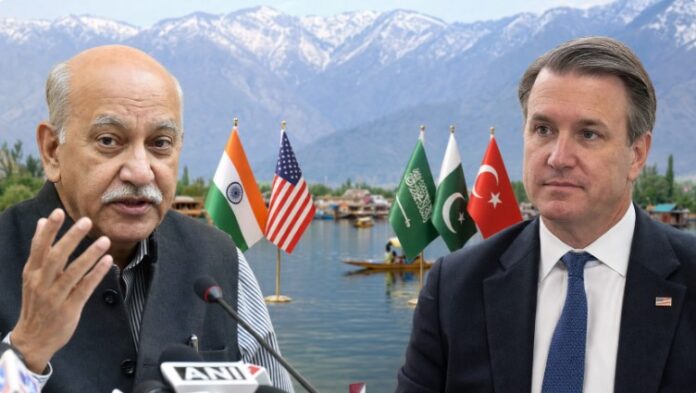
MJ Akbar welcomed US Ambassador Sergio Gor’s Kashmir remark but questioned Washington’s regional strategy and the Saudi-Pakistan-Türkiye defence pact
Former Union minister MJ Akbar on Wednesday welcomed US Ambassador to India Sergio Gor’s description of Jammu and Kashmir as an “important part of India”, but urged Washington to demonstrate consistency in its regional policy and clarify the purpose and direction of the Saudi Arabia-Pakistan-Türkiye Mecca Joint Defence Agreement, while speaking to reporters in Mapusa.
Speaking in Mapusa, Goa, Akbar described Gor’s remarks as “most welcome” and “perhaps long overdue”. However, he cautioned against interpreting a single statement as evidence of a broader transformation in the United States’ approach towards India and Pakistan.
Akbar also raised questions about the Mecca Joint Defence Agreement involving Saudi Arabia, Pakistan and Türkiye, and sought clarification about Washington’s view of the emerging security arrangement.
His comments were reported in a video published by ANI on X.
Akbar welcomes Gor’s Kashmir statement
Gor made the remark during a visit to Srinagar, where he reportedly described Jammu and Kashmir as an “important part of India”. The statement attracted attention because the status of the region remains a persistent source of disagreement between New Delhi and Islamabad.
India maintains that Jammu and Kashmir is an integral part of the country. Pakistan disputes that position and continues to advocate a settlement based on its interpretation of United Nations resolutions.
Former Union minister MJ Akbar welcomed US Ambassador Sergio Gor’s description of Jammu and Kashmir as an “important part of India”, but said Washington must demonstrate consistency. He also sought clarity over the Mecca Joint Defence Agreement involving Saudi Arabia, Pakistan and Türkiye.
Akbar said confidence in the US position would increase if the American ambassador in Islamabad made a similar statement. He argued that Washington has historically viewed India and Pakistan through an interconnected regional framework, an approach he believes should be reconsidered.
He also alleged that people in Pakistan-administered Kashmir were experiencing poverty and persecution, describing Pakistan’s treatment of the territory as colonial. These were Akbar’s political assertions; no supporting evidence was presented during the remarks quoted by ANI.
Pakistan protests against US envoy’s remarks
Gor’s statement has already generated a diplomatic reaction from Islamabad. Pakistan reportedly summoned the US chargé d’affaires and registered a formal protest, arguing that the ambassador’s description was inconsistent with what Islamabad considers Washington’s established position on Kashmir.
Pakistan’s Foreign Office maintains that the region is disputed and that its final status should be decided in accordance with relevant UN Security Council resolutions and the wishes of Kashmiris. India rejects third-party involvement and says issues with Pakistan should be addressed bilaterally.
The contrasting responses illustrate why Gor’s choice of words has acquired significance beyond a routine diplomatic visit.
US travel advisory remains unchanged
Gor also reportedly indicated during his Srinagar visit that the United States would reconsider its travel guidance for Jammu and Kashmir.
At the time of publication, however, the US State Department’s India travel advisory continued to place Jammu and Kashmir, apart from eastern Ladakh and Leh, in its “Level 4: Do not travel” category because of terrorism and civil unrest.
A diplomatic expression of willingness to review an advisory does not itself change the official guidance. Any revision would need to appear formally on the State Department’s website.
Akbar questions change to US military command’s name
Turning to the wider India-US relationship, Akbar criticised Washington’s decision to remove “Indo” from the name of the US Indo-Pacific Command and restore its earlier designation, US Pacific Command.
He interpreted the change as a possible sign that India was being separated from the American security architecture covering the Indian Ocean and West Asia.
The US administration has offered a different explanation. Gor previously said attention should remain on the substance of bilateral defence cooperation rather than the “name on a letterhead”. The command’s geographical area of responsibility has also reportedly remained unchanged.
Moreover, the Trump administration has continued to use “Indo-Pacific” in other official statements. A White House message issued in May 2026 referred expressly to security and prosperity in the Indo-Pacific.
Akbar’s interpretation should therefore be understood as a warning about the possible symbolism of the military renaming, not as confirmation that the United States has formally abandoned the broader Indo-Pacific concept.
Questions raised over the Mecca defence agreement
Akbar also discussed the Mecca Joint Defence Agreement signed by Saudi Arabia, Pakistan and Türkiye on 7 August 2026.
The agreement reportedly contains a collective-defence provision under which an armed attack on one signatory would be treated as an attack on all three. Pakistan and Türkiye have said the arrangement is defensive and is not directed against any particular country.
An Associated Press report on the agreement said the three countries sought to deepen security cooperation amid heightened regional tensions. Pakistan also indicated that other countries could potentially join if they accepted the pact’s principles.
Akbar referred to President Donald Trump’s reported description of the agreement as a “big, bold and important first step”. He asked what later stages might involve and whether the arrangement could eventually develop into a wider Islamic military alliance resembling NATO.
The publicly available agreement does not identify India as an adversary, and no evidence has emerged that its three members have formally designated a common enemy. The expression “Islamic NATO” remains an analytical and political description rather than the pact’s official title.
Akbar seeks clarification about Washington’s role
Akbar claimed that the United States had sponsored or endorsed the trilateral alliance and called on Washington to explain its objectives.
Public reporting confirms that Trump welcomed the pact, but welcoming or endorsing an agreement is not necessarily the same as sponsoring its negotiation or controlling its implementation. No conclusive public evidence establishing direct US sponsorship was available at the time of publication.
Akbar nevertheless argued that the collective-defence clause raises important questions for India, particularly because Pakistan is one of the three signatories.
India’s Ministry of External Affairs has said it is examining the agreement’s implications for national security and regional stability. New Delhi has not publicly concluded that the arrangement is directed against India.
What the remarks mean for India-US relations
Akbar’s comments bring together three separate developments:
- Gor’s politically significant description of Jammu and Kashmir;
- The restoration of the US Pacific Command name; and
- The creation of the Saudi-Pakistan-Türkiye defence framework.
The envoy’s Kashmir remark may be viewed favourably in New Delhi, but its long-term diplomatic significance will depend on whether it is reflected in official US policy, travel guidance and statements made by American representatives elsewhere.
Similarly, the military command’s renaming carries symbolic importance, but it does not by itself prove that operational cooperation between India and the United States has ended or been substantially reduced.
The Mecca agreement presents a more complex question. Its potential effect on India will depend on how the collective-defence clause is interpreted, whether membership expands and what military coordination the signatories actually establish.
Further coverage of India-US relations and Kashmir is available on Hams Live News.
What happens next?
Attention will now focus on whether the US State Department clarifies Gor’s Kashmir statement or revises its travel advisory for the region.
Any response from the American embassy in Islamabad could also indicate whether Washington intends to repeat the same description of Jammu and Kashmir in its dealings with Pakistan.
Regarding the Mecca pact, India is likely to assess its implementation rather than rely solely on its public language. Future joint military structures, membership proposals and operational commitments will determine whether the agreement remains a limited defensive arrangement or develops into a wider regional alliance.
For now, Akbar’s remarks represent his assessment of evolving American and regional policy. They should not be read as an official statement by the Government of India or as verified evidence that Washington sponsored the Mecca agreement.
This report was independently written from MJ Akbar’s remarks carried by ANI and supplemented with official and publicly available sources.

