
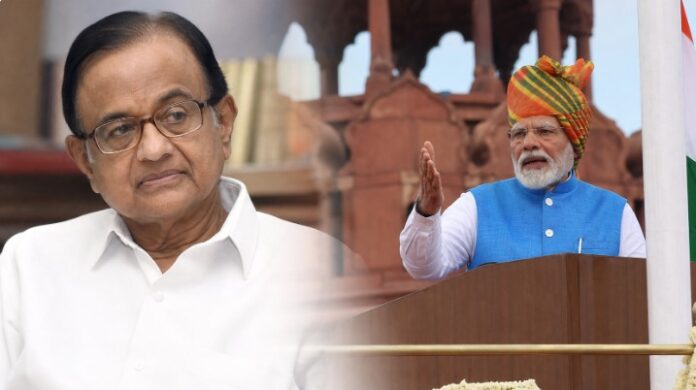
Senior Congress leader P Chidambaram has responded sarcastically to Prime Minister Narendra Modi’s warning about “dimagi Naxals”, declaring that he was proud to accept the label
Senior Congress leader and former Union home minister P Chidambaram on Sunday responded sharply to Prime Minister Narendra Modi’s warning about “dimagi Naxals”, saying he was proud to accept the politically charged label.
“I am proud to be a dimagi Naxal,” Chidambaram wrote in a brief post on X, a day after Modi used his Independence Day address from the Red Fort to warn against people he accused of promoting Maoist ideas from within public institutions.
The Hindi expression “dimagi Naxal” broadly translates as “intellectual Naxal”. Modi used it to describe people who, according to him, support the ideology of armed Maoist groups and seek opportunities to encourage violence and social disorder.
Modi warns of an ideological threat
Addressing the nation from the ramparts of the Red Fort on 15 August, Modi said the government had succeeded in substantially weakening armed Naxalism in forested regions but warned that ideological supporters remained active within society and institutions.
He urged citizens to identify and isolate those who, in his assessment, seek to manipulate policies or push society towards violence and instability.
“For years, people with a Maoist mindset had established themselves in the corridors of power,” Modi said, alleging that some had served as advisers on government committees and influenced public policy.
The prime minister said this ideological challenge should not be underestimated, even as armed Maoist activity declines across the country.
An Associated Press report noted that the phrase echoes the earlier label “urban Naxal”, which BJP leaders have used for some activists, academics and other government critics.
Chidambaram responds with sarcasm
Chidambaram’s statement appeared to challenge the breadth and political use of Modi’s terminology rather than express support for armed Maoism.
By publicly accepting the label, the Congress leader sought to turn the prime minister’s criticism back on the government and highlight concerns that loosely defined political terms could be used to stigmatise dissenting opinions.
Chidambaram, who served as Union home minister during the Congress-led United Progressive Alliance government, had himself overseen security operations against Maoist groups. His response therefore carries added political significance.
The Congress leader did not provide a detailed explanation of his post, but its sarcastic tone suggested that he regarded Modi’s expression as an attempt to categorise ideological or political critics as security threats. His response was published through his official account on X.
https://x.com/PChidambaram_IN/status/2088802890240627139?s=20
Modi highlights impact of Maoist violence
In his speech, Modi said decades of Naxalite and Maoist violence had destroyed the lives and aspirations of millions of young Indians.
He said more than 3,500 police and security personnel had been killed during the conflict, adding that families and communities across affected areas had suffered for decades.
“Naxalism and Maoism have destroyed the future of millions of young people,” the prime minister said. He added that the violence had taken children away from their families and shattered the dreams of parents.
Modi maintained that large parts of India and significant sections of the population had once lived under the threat of armed Maoist groups.
He said his government had made ending Naxalism a priority after taking office in 2014, combining security operations with development programmes in affected districts.
The Union government has previously outlined its security and development strategy against Left-wing extremism, claiming that the number of affected districts and violent incidents has fallen substantially.
Government claims major reduction in violence
Modi said areas once associated with gunfire and bloodshed were now witnessing development, growing public confidence and a stronger presence of government services.
He described the decline of armed Maoist groups as an important achievement of his administration and said long-standing national challenges must eventually be brought to an end.
Official figures have shown a significant reduction in the geographical influence of Maoist organisations over recent years. However, occasional attacks and security operations continue in parts of central and eastern India.
The Maoist insurgency, also known as the Naxalite movement, began with an uprising in Naxalbari, West Bengal, in 1967. It later expanded across several states, with armed groups claiming to represent landless farmers, tribal communities and the rural poor.
Debate over dissent and security
The political controversy centres on where the government draws the line between ideological support for armed violence and legitimate democratic criticism.
Supporters of Modi’s remarks argue that individuals who provide intellectual or institutional support to violent organisations can undermine national security without carrying weapons themselves.
Critics, however, say loosely defined expressions such as “urban Naxal” or “dimagi Naxal” risk being applied to journalists, academics, lawyers, campaigners and political opponents who criticise government policies but do not advocate violence.
This concern has become more prominent amid recent youth-led protests and debates over civil liberties. Hams Live News previously examined the wider questions surrounding youth mobilisation, dissent and the Cockroach Janta Party.
Congress questions Modi’s terminology
Other Congress leaders have also criticised the prime minister’s remarks. Congress leader Jairam Ramesh argued that the BJP had previously branded some critics as “urban Naxals” and was now replacing that expression with “dimagi Naxals”.
He accused the government of dismissing ideas as extremist when they are proposed by the opposition, only to adopt some of them later. Ramesh cited the caste census as an example. The BJP had not issued a detailed response to Chidambaram’s post at the time of publication.
A political battle over language
Chidambaram’s response has transformed Modi’s national security warning into a broader political debate over language, opposition and freedom of expression.
The government maintains that ideological networks associated with armed Maoist groups remain a genuine threat despite the decline in insurgent violence.
The opposition, meanwhile, is likely to continue questioning whether labels such as “dimagi Naxal” are being used too broadly against people who disagree with government policy.
The controversy is therefore no longer limited to the status of armed Naxalism. It also raises a larger democratic question: how should India distinguish between support for violence and the lawful expression of dissent?

