
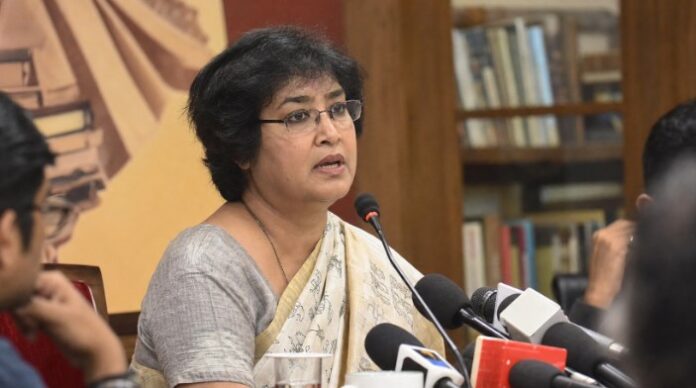
Speaking in Kolkata, author and activist Taslima Nasrin called for stronger regulation of madrasas, secular education reforms and a Uniform Civil Code across India.
Author and activist Taslima Nasrin triggered controversy on Sunday after making sharply critical remarks about madrasas, religious institutions and religiously based personal laws during an interaction with journalists in Kolkata.
Speaking at the Bangla Academy, Nasrin called for all madrasas to be brought under government supervision and proposed converting religious seminaries into secular schools. She also reiterated her support for a Uniform Civil Code that would apply the same civil laws to citizens of every religion.
Her comments included serious allegations about some madrasa institutions. No supporting evidence for those allegations was cited during the reported interaction, and they should not be interpreted as findings against madrasas generally.
Nasrin makes contentious allegations about madrasas
Nasrin alleged that some madrasas operate as “factories for producing jihadis” and claimed that incidents of sexual abuse occur within certain institutions. She argued that madrasas should not continue operating in their present form.
These claims have not been independently verified. No particular institution, police complaint, official investigation or judicial finding was identified in the remarks provided for this report.
Nasrin further claimed that many madrasas operate without adequate government oversight and that some children are taught to resent people belonging to other religions. She accused political parties of avoiding strict action because of electoral considerations, arguing that this reluctance allows extremism to grow.
Her statements concern a diverse group of institutions. The term “madrasa” may refer to government-run, government-aided, recognised private or independent religious institutions, each of which can have different curricula and systems of oversight.
West Bengal already has a substantial network of recognised madrasas operating under the state’s Minority Affairs and Madrasah Education Department. Nasrin did not specify whether her criticism applied to these institutions, independent seminaries or both.
Proposal to convert madrasas into secular schools
Calling for extensive educational reform, Nasrin said all madrasas should be subject to government regulation. She contended that some graduates leave religious institutions without the wider academic or vocational skills required for employment.
She therefore proposed converting madrasas into secular schools that teach a broader curriculum and prepare students for a wider range of careers.
Any such policy would involve constitutional questions concerning educational rights, religious freedom, equality and the state’s authority to regulate educational standards. It would also require consultation with students, parents, educators and affected communities.
Remarks about mosques and religious institutions
Nasrin also questioned what she described as an excessive number of mosques and other religious buildings. She argued that the government should regulate religious institutions as part of a broader effort to counter fanaticism.
Her comments are likely to prompt debate over the distinction between legitimate government oversight—such as building, financial and public-safety regulation—and constitutionally protected religious activity.
The author has frequently criticised organised religion and religious fundamentalism. She identifies as an atheist and secular humanist and says she opposes religious rules or customs that discriminate against women.
Criticism of religion and women’s rights
Responding to questions about her longstanding opposition to religion, Nasrin said criticism is necessary when religious beliefs or practices deny women equal rights.
She maintained that social reform requires challenging traditions that perpetuate discrimination. Nasrin has previously criticised multiple religions, although her writings on Islam have generated particularly intense controversy.
Born into a Muslim family in Bangladesh, Nasrin later rejected religious belief. Her writing on religion, patriarchy and women’s rights led to protests and threats, and she has lived outside Bangladesh for many years.
Nasrin left Kolkata in 2007 following violent protests over her presence and writings. Her latest visit marked her return to the city after nearly two decades, according to reports published before the event. The Statesman and India Today reported that she was invited to participate in an anti-fundamentalism literary programme.
Warning over student movements
Commenting on recent student protests in Delhi, Nasrin said the images reminded her of the 2024 student-led uprising in Bangladesh.
She claimed that extremist groups later exerted influence over the movement in Bangladesh and cautioned that student-led protests do not invariably produce positive political outcomes.
Nasrin did not dismiss student activism altogether, but argued that such movements should be judged by their leadership, direction and eventual consequences.
Support for a Uniform Civil Code
Nasrin also repeated her support for implementing a Uniform Civil Code throughout India.
Invoking the principle of “one nation, one law,” she argued that citizens should be governed by equal civil rules regardless of religion. Civil-law matters potentially covered by such a code include marriage, divorce, inheritance and adoption.
Supporters say a common code could advance legal equality, particularly for women. Critics argue that its design and implementation must protect religious freedom, cultural diversity and minority rights.
Nasrin has advocated a common civil code on previous occasions, linking the issue to secularism and gender equality. Her latest remarks place that demand within her broader criticism of religious personal laws.
Remarks likely to intensify debate
Nasrin’s statements bring together several contentious questions: freedom of expression, regulation of religious education, protection of minorities, women’s equality and the limits of state intervention in religion.
Her right to criticise religion does not establish the accuracy of factual allegations made about particular institutions. Claims of criminal abuse or extremist instruction require evidence and investigation by the appropriate authorities.
Responses from madrasa representatives, education officials and religious organisations were not included in the material available for this report. Their views should be added if the story is updated.
Editor’s note: This report attributes disputed statements directly to Taslima Nasrin. Allegations concerning abuse, extremist instruction or institutional misconduct have not been independently verified.

