
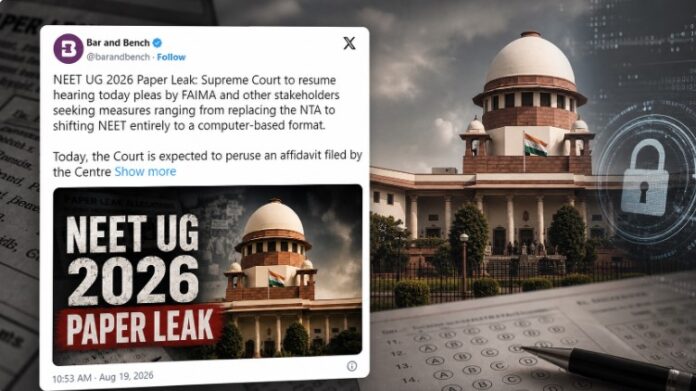
The Supreme Court has sought details of steps to strengthen the NTA and implement technology-led reforms following the alleged NEET-UG 2026 paper leak.
The Supreme Court has stressed the need to transform the National Testing Agency into a stable and professionally equipped institution, observing that permanent expertise and technological capacity are essential to preventing question-paper leaks and other failures in national entrance examinations.
A Bench comprising Justices P.S. Narasimha and Alok Aradhe made the observations while considering a group of petitions arising from the alleged NEET-UG 2026 question-paper leak.
The Court directed the Union government to file an affidavit explaining the progress made in implementing the recommendations of the K. Radhakrishnan committee, together with the technology-related reforms being considered by a task force headed by Nandan Nilekani.
The case is expected to be heard again after three weeks.
The Supreme Court has said the National Testing Agency must be developed into a robust institution capable of retaining expertise and safely conducting entrance examinations. The Centre has been directed to report on measures proposed by the Radhakrishnan and Nandan Nilekani panels.
Court focuses on institutionalising the NTA
The Bench said its principal concern was not limited to security arrangements for a single examination. It wanted to know how the government planned to build a permanent system capable of preserving expertise and improving its procedures from one examination cycle to the next.
The Court observed that when experienced officials are transferred without an institutional mechanism to retain their knowledge, the organisation loses valuable operational experience.
It called for a “vibrant” institution supported by adequate staff, secure premises, confidential operational infrastructure, cybersecurity systems and dedicated research and development facilities.
The Court also sought information about senior appointments, examination centres, central network operations, secure data storage and the proposed creation of specialised divisions within the NTA.
The National Testing Agency conducts NEET-UG and several other entrance and eligibility examinations for higher-education institutions.
Centre asked to report on committee recommendations
The government must explain the action taken on recommendations made by the high-level committee led by former Indian Space Research Organisation chairman K. Radhakrishnan.
The committee was established after the NEET-UG 2024 controversy to examine examination security, data-protection procedures and the structure and functioning of the NTA. Its recommendations included reducing dependence on outsourced service providers for critical work and developing greater capacity within the agency. The committee’s report is available through the Ministry of Education.
The Supreme Court has also requested details about the recommendations of the Nandan Nilekani-led task force. According to submissions placed before the Court, the task force has been examining potential applications of artificial intelligence, blockchain and other technologies in public examinations.
The Court, however, indicated that technology would have to form part of a wider institutional structure rather than serve as a substitute for trained personnel, accountability and permanent infrastructure.
Government describes existing security arrangements
Solicitor General Tushar Mehta outlined the safeguards reportedly used during the preparation, printing, transportation and distribution of examination papers.
According to the government’s submission, multiple sets of papers are prepared before the NTA director-general selects those to be used. Identified printing facilities operate under CCTV monitoring and security surveillance, while access to confidential material is controlled.
Question papers are subsequently sealed, transported in GPS-tracked vehicles and stored in bank strongrooms. The final set is communicated to authorised officials on the morning of the examination, the Court was told.
The government maintained that the system contains several layers of protection, although some stages still involve human intervention.
Computer-based NEET remains under consideration
Several petitioners have asked the Court to direct a transition from the existing pen-and-paper examination to a computer-based test, or CBT.
The Centre has previously informed the Supreme Court that such a change is under active consideration, but that a final decision would take into account the Nilekani task force’s recommendations. Computer-based examinations could reduce the need to print and transport physical question papers, although they would also require secure digital infrastructure and sufficient testing facilities throughout the country.
Questions concerning cybersecurity, rural access, regional-language support, server capacity and the protection of candidate data would also have to be addressed before a nationwide transition.
Readers can follow related developments through Hams Live News’ NEET coverage.
Petitions seek restructuring and greater accountability
One of the petitions was filed by the Federation of All India Medical Association. It seeks the replacement or comprehensive restructuring of the NTA, along with measures including digital locking of question papers, centre-wise publication of results and a transition to computer-based testing.
Details of the petition are available in the original Bar & Bench report on the challenge.
A separate petition by the United Doctors Front calls for the establishment of a statutory national testing body with stronger oversight and direct parliamentary accountability.
Another challenge has reportedly been brought by RJD MP Sudhakar Singh and other petitioners, who have also requested a computer-based NEET-UG examination and the creation of an independent examination authority.
These demands remain before the Court and should not be treated as final directions already issued to the government.
The background to the reform proceedings
The NEET-UG examination faced a confirmed but geographically limited paper leak in 2024. The Supreme Court concluded at the time that the available evidence did not establish a systemic breach affecting the examination nationwide and declined to order a fresh test for every candidate.
Nevertheless, the Court directed the authorities to address weaknesses in the examination process. The Supreme Court’s August 2024 judgment set out its findings and directions concerning the integrity of NEET-UG.
Following fresh allegations surrounding NEET-UG 2026, the Court resumed its examination of the NTA’s structure and the safeguards used to conduct the test. An earlier Supreme Court order dated 29 May 2026 required the Centre to explain how lessons from successive examination cycles would be institutionalised.
What happens next?
The Union government’s forthcoming affidavit is expected to address:
- Implementation of the Radhakrishnan committee’s recommendations;
- Proposals made by the Nandan Nilekani task force;
- Staffing and senior appointments within the NTA;
- Secure data storage and sovereign examination databases;
- Cybersecurity and confidential operational infrastructure;
- Research and development capacity;
- Permanent examination centres and network operations; and
- The feasibility of conducting NEET-UG as a computer-based test.
The next hearing could clarify whether the Court will prescribe a timetable for structural reforms or allow the government and expert panels to determine how and when individual measures should be implemented.
For candidates, the immediate significance of the proceedings is that the Court is examining long-term institutional reform rather than only the handling of one disputed examination. No final direction replacing the NTA or shifting NEET-UG to computer-based testing has yet been issued.
This article is an independently rewritten report based on court proceedings first reported by Bar & Bench, supplemented with official court documents and publicly available information.

