
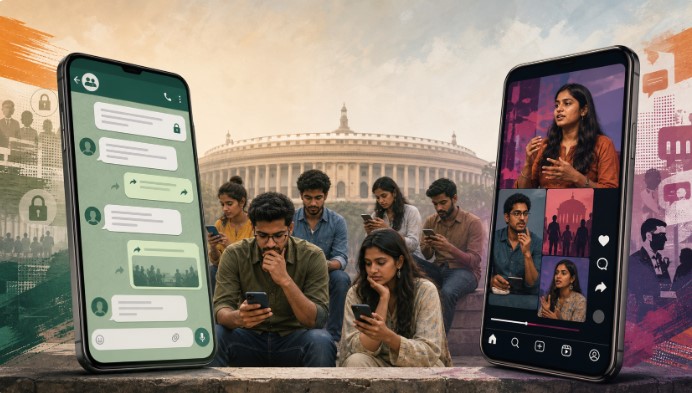
How the WhatsApp generation shaped the BJP and the Instagram generation is challenging it
India’s political conversation is moving from the closed networks of WhatsApp to the public, visual and unpredictable world of Instagram. This is not simply a change in social media preferences. It reflects a deeper generational shift in how young Indians consume information, respond to authority and participate in democratic life.
The rise of the Bharatiya Janata Party coincided with the rapid expansion of smartphones, inexpensive mobile data and WhatsApp groups across India. The party recognised earlier than most of its rivals that political communication no longer had to pass through television studios, newspaper offices or formal rallies. It could travel directly from one mobile phone to another.
WhatsApp proved ideally suited to this political moment. Messages circulated through families, neighbourhoods, professional associations and local party networks. Campaign material could be distributed quickly and inexpensively, while supporters were given a sense of direct participation in a larger political movement.
But the generation now entering India’s political conversation has been shaped by a different digital environment. Its favoured platforms are more visual, public and personality-driven. Instagram users do not merely receive political messages; they comment on them, parody them, remix them and challenge them in front of an audience.
The result is a more volatile political arena – one that may prove harder for any party to control.
The political power of the WhatsApp generation
The expression “WhatsApp generation” refers broadly to those whose political habits developed alongside the spread of smartphones and messaging applications during the 2010s.
WhatsApp enabled political organisations to create extensive communication networks at comparatively little cost. Party workers could distribute speeches, slogans, videos, campaign instructions and responses to breaking developments within minutes. Messages often acquired credibility because they came from a relative, friend, colleague or trusted local contact.
For the BJP, these networks became a formidable political asset. They helped the party communicate directly with voters, mobilise volunteers and reinforce a shared political identity among supporters. The platform’s private, group-based structure also allowed messages to circulate beyond the scrutiny normally applied to public broadcasts.
That strength, however, is also WhatsApp’s weakness. Information shared within trusted groups is not always subjected to serious verification. Emotionally charged claims can travel rapidly, while corrections rarely receive the same attention as the original message.
This problem is not confined to the BJP or to India. It is part of a wider democratic challenge created by encrypted messaging platforms. Nevertheless, WhatsApp’s importance to Indian political mobilisation makes it central to any discussion about the country’s digital politics.
Instagram changes the political language
The emerging “Instagram generation” should not be treated as a single ideological group. Young Instagram users hold diverse – and often conflicting – political opinions. What distinguishes them is not necessarily what they believe, but how they encounter and communicate those beliefs.
Their political world is built around reels, stories, livestreams, infographics, memes and creator-led commentary. Politics appears alongside fashion, entertainment, sport and popular culture. A parliamentary speech, street protest and celebrity video may compete for attention in the same feed.
This environment rewards a style of political communication very different from the long messages and repeated slogans common on WhatsApp. Instagram favours immediacy, visual appeal, emotional recognition and individual personality. A message must not only be persuasive; it must be engaging enough to stop the user from scrolling.
More importantly, Instagram is a comparatively public space. Political claims can be questioned immediately. Speeches can be converted into satirical clips, while official narratives may be challenged by photographs, eyewitness videos and alternative interpretations.
Political communication consequently becomes less predictable. Parties may publish a carefully designed message, but they cannot determine how users will interpret, edit or redistribute it.
Young voters are not passive audiences
The political significance of this transition lies in the expectations of younger voters. Many are less willing to accept one-way communication from political parties. They expect public figures to answer questions, acknowledge criticism and demonstrate some degree of authenticity.
Their engagement is often organised around particular concerns rather than permanent party loyalty. Employment, competitive examinations, education, air pollution, climate change, women’s safety, digital privacy, social inclusion and freedom of expression all feature prominently in online discussions.
These priorities vary across class, caste, gender, region, religion and language. India’s youth cannot be compressed into a single political category. A university student in Delhi, a first-time voter in a small town and a young worker in rural India may have profoundly different experiences.
Even so, social media allows local grievances to enter national conversations with unprecedented speed. An examination controversy, environmental protest or allegation of official misconduct can acquire nationwide visibility within hours.
The young people participating in these conversations do not always belong to formal political organisations. Many enter public debate through cultural commentary, comedy, lifestyle content or personal storytelling. That makes their political influence difficult to measure – but equally difficult to dismiss.
The BJP’s next digital challenge
The BJP remains one of India’s most sophisticated political organisations in its use of technology. Its experience with digital campaigning and volunteer networks gives it a substantial advantage over many competitors.
Yet success on WhatsApp does not automatically translate into influence on Instagram. The two platforms demand different political instincts.
WhatsApp rewards discipline, repetition and networked distribution. Instagram rewards personality, creativity, speed and public interaction. A conventional press statement may circulate effectively through messaging groups but disappear unnoticed from a visually crowded Instagram feed.
The BJP therefore faces a challenge that is cultural as much as technological. It must communicate with young voters who may appreciate the party’s confidence and organisational strength but remain critical of its record on employment, social freedoms, education or environmental policy.
Adopting fashionable graphics or working with influencers will not be enough. Younger audiences are particularly alert to political communication that appears artificial or excessively managed. To retain their attention, the party will have to show that it is listening to their concerns rather than merely repackaging old messages in new formats.
This challenge is not unique to the BJP. Every major Indian political party must learn how to communicate with an audience that expects both immediacy and accountability.
The limits of digital control
The rise of visual social media is particularly significant in cities and university communities, where internet access and digital participation tend to be higher.
A protest or official confrontation can now be documented from several angles and circulated before a formal response is issued. Citizens can compare statements with visual evidence, organise public discussions and connect local events to wider debates about rights and governance.
This does not make political pressure or institutional control irrelevant. Nor does it mean that online activism necessarily produces electoral change. A viral campaign may dominate public attention for several days and then vanish without creating lasting organisation.
Digital access also remains unequal. Political attitudes are shaped by far more than social media, particularly in regions where community networks, local leaders, television and vernacular newspapers remain influential.
Still, the growth of digital activism makes it harder for any government or political party to exercise complete control over a national narrative. Attempts to suppress criticism may themselves become visual events, generating wider attention than the original controversy.
Not every Instagram user is a dissenter
It would be misleading to imagine the WhatsApp generation as uniformly loyal to the BJP and the Instagram generation as inherently opposed to it. Political behaviour is never so tidy.
Many Indians use both platforms. Content regularly moves from Instagram to WhatsApp, then to YouTube, Facebook, X and regional-language networks. Young users can be socially progressive on one issue and deeply conservative on another. They may criticise the government while continuing to support it electorally.
The real divide is therefore not between two applications or two fixed political camps. It is between different forms of communication.
The older model depends heavily on controlled distribution through trusted networks. The emerging model is more public, fragmented and difficult to manage. Political authority is not necessarily weakened, but it is subjected to continuous commentary.
A more engaged electorate – or a more polarised one?
The growth of social media can strengthen democracy by allowing more people to enter public debate. Citizens who once depended on political parties or large media organisations to raise an issue can now present evidence, tell their own stories and attract public support.
But greater participation does not automatically produce better information. Instagram can spread misleading material as rapidly as WhatsApp. Its emphasis on appearance and emotion may reduce complicated political questions to striking images or simplistic slogans.
Algorithms tend to reward outrage, conflict and certainty. Careful explanations rarely travel as quickly as dramatic accusations. The same tools that allow citizens to hold power to account can also be used to intimidate individuals, deepen social divisions and manufacture false impressions of public opinion.
India’s digital future will therefore depend not only on how political parties use social media, but also on whether citizens develop stronger habits of verification and critical engagement.
India’s political future will be multi-platform
WhatsApp transformed political mobilisation in India by helping parties create direct and extensive networks of communication. Instagram is now changing the nature of that communication by making it more visual, public and interactive.
This does not necessarily foreshadow the decline of the BJP. The party has repeatedly demonstrated its ability to adapt to new political conditions. But it does suggest that the methods that helped establish its digital dominance may not be sufficient to preserve it indefinitely.
Younger voters do not simply want political messages delivered through newer applications. They want politics to address the anxieties and aspirations shaping their lives. They expect employment opportunities, credible institutions, social dignity and a meaningful voice in public affairs.
The contest for India’s political future will not be decided by WhatsApp or Instagram alone. It will be decided by how effectively political parties understand the citizens using them.

