
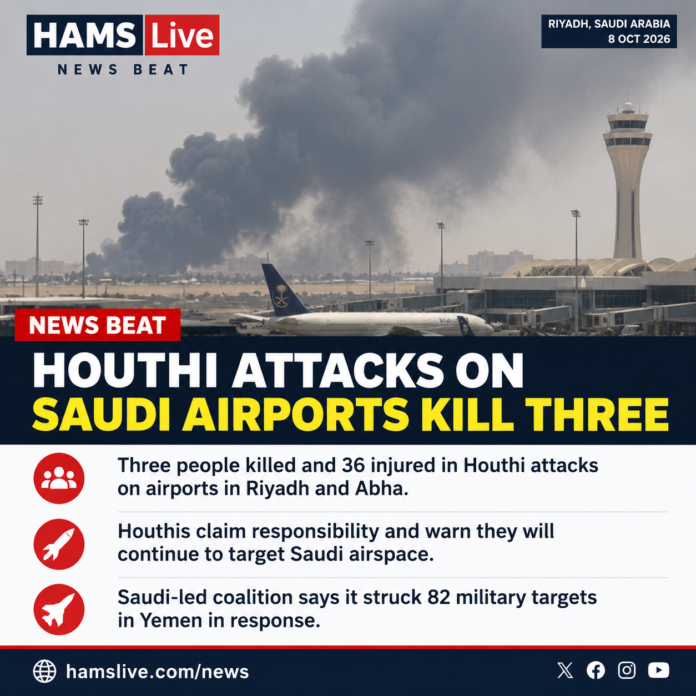
Deadly strikes on airports in Riyadh and Abha leave 36 injured as Saudi-led forces retaliate with attacks on Houthi military targets in Yemen
Three people were killed and 36 others injured in Houthi attacks on two Saudi Arabian airports this week, as fighting between the Iran-aligned Houthi movement and Saudi-backed Yemeni government forces intensifies and threatens to widen the regional conflict.
Saudi Arabia’s General Authority of Civil Aviation said two separate attacks targeted King Khalid International Airport in Riyadh and Abha International Airport. At King Khalid Airport, a Sudanese national was killed and eight people were injured. At Abha, two women, one Moroccan and one Algerian, were killed and 28 people were injured. The attacks also caused property damage, according to the Saudi aviation authorities. Reuters reported the latest casualties and the escalation in fighting.
The Houthis claimed responsibility for the attacks. Their military spokesperson, Brigadier General Yahya Saree, said the group had targeted the two airports with drones and missiles and warned that Saudi airspace would remain a target. The claims could not independently be verified, while Saudi authorities confirmed that the two airports had been attacked.
Saudi Arabia retaliates with strikes on Houthi targets
The attacks triggered a military response from the Saudi-led coalition supporting Yemen’s internationally recognised government. Coalition spokesperson Major General Turki al-Maliki said the forces had carried out a large-scale operation against Houthi positions in several Yemeni provinces.
The coalition said it destroyed 82 Houthi military targets across Yemen, including 11 ballistic-missile storage facilities in mountainous areas of Saada. Command and control centres, communications systems, weapons depots and other military positions were also listed among the targets.
Al-Maliki described the airport attacks as attacks on civilians and civilian infrastructure and said they would not go unanswered. The exchange marks another sharp escalation in a conflict that had remained comparatively subdued following a 2022 truce.
Fighting intensifies across Yemen
The latest attacks come as Saudi-backed Yemeni government forces and the Houthis fight across several fronts inside Yemen. Government forces, supported by Saudi air power, have launched a major counteroffensive aimed at recovering territory captured by the Houthis, particularly along the Red Sea coast and around the strategic Bab el-Mandeb Strait.
The renewed fighting follows a period of relative calm after an informal truce took effect in April 2022. The truce substantially reduced cross-border attacks and fighting, although it never developed into a comprehensive permanent peace agreement. Tensions began rising again during 2026, culminating in renewed attacks and the Houthi announcement of a naval blockade against Saudi Arabia in July.
The Houthis have said their actions are a response to what they describe as Saudi pressure and restrictions on Yemen. Saudi Arabia, meanwhile, continues to support the internationally recognised Yemeni government and regards the Houthi movement as a major security threat along its southern border.
Saudi Arabia intervened militarily in Yemen in 2015 after the Houthis seized the capital, Sana’a, and the internationally recognised government requested outside support. The conflict has since developed into one of the region’s most complicated wars, involving competing Yemeni factions as well as wider regional rivalries.
Strategic importance of the Bab el-Mandeb Strait
The latest escalation is particularly significant because of the strategic importance of the Bab el-Mandeb Strait, the narrow maritime passage connecting the Red Sea with the Gulf of Aden and the wider Indian Ocean. The waterway is an important route for international shipping and energy supplies, making renewed fighting along Yemen’s western coast a concern well beyond the immediate battlefield.
Saudi-backed Yemeni forces recently launched an offensive to push the Houthis away from parts of the Red Sea coast and regain control of territory around the strategic waterway. The offensive has focused on territory around Bab el-Mandeb and the port of Mocha, adding another strategic dimension to the renewed conflict.
The Houthi blockade announcement in July had already raised concerns about disruption to maritime trade and Saudi oil exports. Any prolonged instability around the Red Sea and Bab el-Mandeb could further complicate shipping routes at a time when other major energy corridors are already facing disruption.
Yemen faces a worsening humanitarian crisis
Beyond the military calculations, the renewed fighting is deepening the humanitarian crisis in Yemen. More than 200,000 people have been displaced since the latest phase of fighting began in September, according to the UN’s International Organization for Migration. The displacement has affected multiple governorates and placed additional pressure on communities already struggling with food shortages and inadequate shelter.
The latest UN-backed displacement figures underline the human cost of the renewed conflict. Humanitarian organisations have warned that continued fighting could further restrict access to food, healthcare and other essential services.
Yemen was already facing one of the world’s most severe humanitarian emergencies before the latest escalation. The renewed battle for territory, combined with disruption to transport and trade routes, risks worsening conditions for civilians caught between competing armed forces.
Saudi Arabia’s growing regional security concerns
The airport attacks also highlight the growing security pressures facing Saudi Arabia as the conflict in Yemen becomes increasingly intertwined with wider regional tensions. Riyadh has sought to protect its airports, energy infrastructure and maritime routes while supporting Yemeni government forces on the battlefield.
Recent developments have also affected Saudi Arabia’s wider diplomatic and security calculations. Hams Live previously reported on Saudi efforts to maintain diplomatic engagement with Iraq amid wider regional security tensions. The developments underline the increasingly interconnected nature of security challenges facing Gulf states.
The renewed conflict is also being watched closely because of its potential effect on energy markets and international shipping. The Bab el-Mandeb is one of the world’s strategically important maritime passages, while the wider Middle East is already experiencing disruptions to major energy routes.
Houthis warn of further attacks
The Houthis have warned that their campaign against Saudi targets will continue. Their military leadership has said Saudi airports and airspace could remain targets as long as the group considers the Saudi military campaign in Yemen to be continuing.
For Saudi Arabia, however, attacks on civilian airports represent a direct challenge to the country’s domestic security and its efforts to maintain normal air travel. Saudi aviation authorities said emergency teams responded to the attacks and that officials were assessing damage and taking measures to protect passengers and maintain the safety of civil aviation operations.
The latest exchange of strikes therefore risks creating another cycle of attack and retaliation: Houthi missile and drone attacks on Saudi territory followed by Saudi-led airstrikes on Houthi military infrastructure inside Yemen.
A conflict with no easy military solution
The renewed fighting demonstrates how difficult it remains to resolve the Yemen conflict through military means alone. The Houthis retain significant military capabilities and control substantial territory, while the internationally recognised government depends heavily on external military and financial support.
Saudi Arabia’s intervention in 2015 was intended to restore the internationally recognised government after the Houthis seized Sana’a. More than a decade later, the conflict remains unresolved, while the latest escalation has once again brought the war directly to Saudi airports and strategic infrastructure.
The deaths at Abha and King Khalid airports are therefore more than another episode in a long-running conflict. They signal a potentially dangerous new phase in which civilian infrastructure, aviation and strategic waterways are increasingly caught up in the fighting.
With Saudi-backed forces attempting to recover territory along the Red Sea coast and the Houthis threatening further attacks on Saudi targets, the immediate challenge is to prevent another prolonged escalation while addressing the humanitarian consequences for millions of Yemenis.
For now, however, the latest exchange of attacks suggests that the fragile period of relative calm that followed the 2022 truce has given way to a far more dangerous confrontation.

