
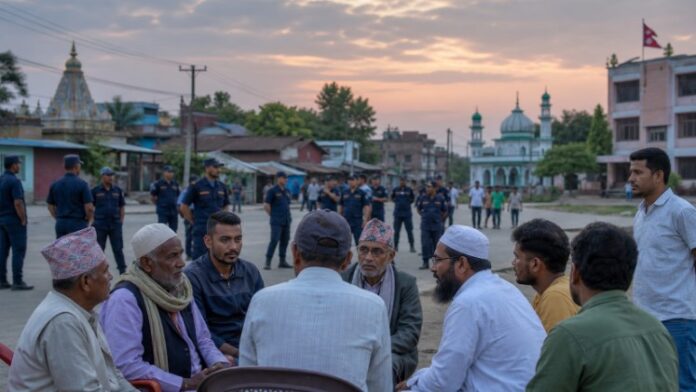
Four people died after a local dispute in Nepal’s Sunsari district triggered police firing and wider unrest, raising concerns over communal polarisation
A dispute over religious flags and loud music during a Bolbam procession in Nepal’s Sunsari district escalated into clashes, police firing and protests across several Terai districts, leaving four people dead and prompting fresh debate over religious mobilisation, policing and communal harmony in the country.
The initial confrontation occurred in Kaptanganj, Ward 3 of Dewanganj Rural Municipality, on the night of 26 July 2026. According to police and local reporting, Hindu devotees returning with holy water from the Koshi Barrage were playing amplified music when members of the local Muslim community objected.
Reports also said tensions had developed earlier over the removal of a Muslim religious flag from an electricity pole and its replacement with a Hindu flag. Stone-throwing followed, with police saying personnel were attacked by people from both sides.
Security forces subsequently opened fire while attempting to disperse the crowd.
A dispute involving religious flags and loud music during a Bolbam procession in Nepal’s Sunsari district escalated into clashes, police firing and protests across the Terai. Four deaths were later linked to the unrest, prompting investigations and renewed calls for communal harmony.
Four deaths linked to the unrest
One person was initially reported dead and more than 20 people were injured, including police and Armed Police Force personnel. The number of fatalities later increased as two other people wounded during the Dewanganj firing died in hospital.
A fourth person, a teenager, was fatally shot during subsequent unrest in Golbazar in neighbouring Siraha district. Nepal’s Cabinet later recognised all four people killed in the Sunsari and Siraha incidents as martyrs, according to an updated report by The Kathmandu Post.
The circumstances of the Siraha shooting remained under investigation, with authorities yet to determine who fired the fatal shot.
This chronology is important because some early accounts reported only one or three deaths. Later official and local reports put the combined toll from the unrest in Sunsari and Siraha at four.
Protests spread across the Terai
News of the police firing prompted demonstrations and confrontations in Sunsari, Saptari, Siraha, Dhanusha and Parsa. Authorities imposed curfews or prohibitory orders in several locations and deployed additional security personnel to prevent further violence.
Nepalese media reported vandalism, arson and clashes with police during the unrest. Social-media posts also carried allegations of attacks on religious buildings and private property, but not every video or claim circulating online could be independently authenticated.
Prime Minister Balendra Shah appealed to citizens, political parties, religious organisations and the media to exercise restraint and preserve peace, brotherhood and national unity. He also promised an impartial investigation and accountability for those responsible.
An international account of the government’s response was published by Al Jazeera.
Government action helps restore calm
Tensions began to ease after negotiations involving the government, the families of those killed, local authorities, political parties and community representatives.
The authorities agreed to investigate the shootings, provide financial assistance to affected families and support the treatment of people injured during the violence. Peace rallies were subsequently organised in several districts.
By 4 August, public life was returning to normal in the affected areas, although security personnel remained alert. The Kathmandu Post’s ground report noted that Kaptanganj had no previous history of serious Hindu-Muslim violence.
Hindu organisations submit demands
During the protests, a coalition called the Joint Hindu Front presented a 13-point memorandum to Nepal’s Home Minister Sudan Gurung.
The demands reportedly included compensation and an investigation into the police firing, as well as stricter regulation of weapons displayed during religious events. One proposal sought an all-party discussion on restoring Nepal’s status as a Hindu state.
Some initial reports described the meeting as an agreement between the government and the organisations. Officials later clarified that the government had received the memorandum but had not formally agreed to restore a Hindu state or accepted every demand.
The distinction is significant because receiving a political memorandum does not amount to endorsing its proposals. The controversy surrounding the document was examined in a Kathmandu Post report.
Nepal was officially a Hindu kingdom until 2007 and became a secular republic under its subsequent constitutional framework. Calls to restore a Hindu state remain part of Nepal’s domestic political debate.
Allegations against religious groups require investigation
An opinion article published by the Center for the Study of Organised Hate accused several Nepal-based Hindu organisations of exploiting the deaths and directing anger towards Muslims. It also alleged that some of these organisations were influenced by Hindu nationalist movements in India.
The original CSOH article cited online videos, public demonstrations and similarities in names and rhetoric as evidence of cross-border ideological influence.
These claims require careful qualification. Publicly available reporting confirms that Nepalese Hindu organisations participated in protests and submitted demands to the government. However, similarity in terminology, religious symbols or organisational names does not by itself prove operational control, funding or direction from India.
No verified evidence reviewed for this report established that the Government of India, an Indian political party or any Indian institution organised the Sunsari violence. The unrest was a Nepalese law-and-order matter involving local actors and Nepal’s security agencies.
Nepalese authorities should investigate any organisation or individual suspected of inciting violence, irrespective of religious or political affiliation. Responsibility should be based on evidence and individual conduct, not nationality or an entire religious community.
Security agencies had warned of polarisation
The unrest did not emerge in a complete vacuum. Nepal’s Armed Police Force had reportedly warned the government several years earlier about growing religious and ethnic polarisation in the Terai.
According to The Kathmandu Post, the security assessment raised concerns about organisations associated with both Hindu and Muslim communities and recommended closer coordination among government agencies, local administrations and political leaders.
This broader warning is important because it challenges attempts to place responsibility for Nepal’s communal tensions exclusively on one religion or on a neighbouring country.
The Sunsari violence appears to have resulted from a combination of local disputes, provocative actions, rumours, rapid social-media circulation, crowd mobilisation and failures in early conflict prevention.
Social media intensified tensions
Videos and unverified claims spread quickly after the police firing, sometimes without clear information about their date, location or context. Such content can deepen fear and provoke retaliatory mobilisation before authorities or journalists establish what happened.
Religious processions, amplified music, flags and routes passing through mixed neighbourhoods have become predictable points of friction in parts of South Asia. These issues require advance consultation rather than restrictions aimed selectively at one community.
Local administrations can reduce risks by agreeing on procession routes, sound limits, timings and rules governing religious symbols before major events. Rapid-response committees involving police, elected representatives and respected figures from every community could also prevent minor disputes from escalating.
India should not be blamed without evidence
Nepal and India share an open border as well as extensive cultural, religious and family connections. Ideas and political language naturally move in both directions, particularly across the Terai.
Nevertheless, cultural or ideological similarity is not evidence of state involvement. Presenting Nepal’s internal violence as an Indian operation without verifiable proof would be inaccurate and could create further hostility.
The responsible question is whether specific people or organisations—Nepalese or foreign—provided money, instructions or logistical assistance for unlawful activity. Such findings must come from a credible investigation, not assumptions based solely on religious identity or political vocabulary.
India has a clear interest in a peaceful, stable and harmonious Nepal. Communal tension along the border can affect trade, travel, local livelihoods and security in both countries.
Readers can follow other developments concerning Nepal and India through Hams Live News.
Protecting Nepal’s social cohesion
Nepal’s Hindu and Muslim communities have lived alongside one another for generations, and the actions of violent individuals should not be attributed collectively to either community.
The immediate priority is an impartial investigation into the police firing, the fatal shooting in Siraha, attacks on people and property, and any organised incitement. The findings should be made public, and those responsible should face action under Nepalese law.
Political and religious organisations also have a responsibility to avoid inflammatory language and prevent legitimate grievances from being converted into hostility against an entire community.
The central lesson from Sunsari is not that one religion or neighbouring country caused Nepal’s problems. It is that a local dispute can become a wider crisis when institutions respond slowly, rumours spread rapidly and political groups use communal grievances for mobilisation.
This independently rewritten report draws on Nepalese media, official accounts and international reporting. The CSOH article has been treated as commentary, and its allegations have not been presented as established facts.

